
Supreme Court Rulings Set to Influence 2026 Midterm Maps
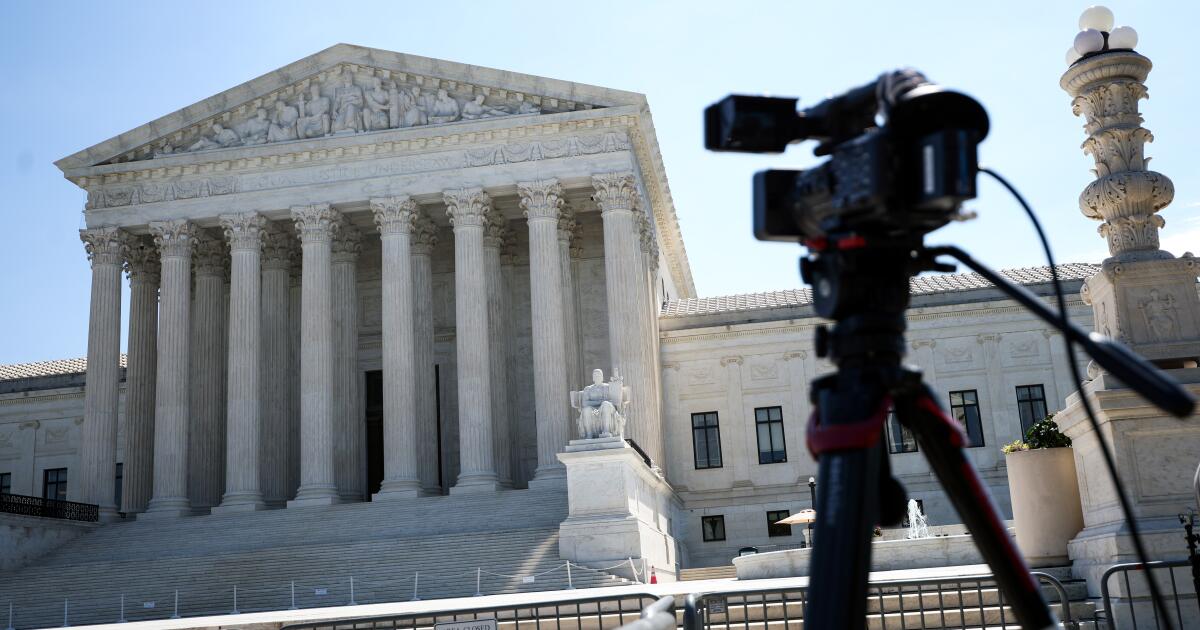
Cover image from latimes.com, which was analyzed for this article
The Supreme Court is set to decide major cases in June that could significantly impact the 2026 midterm elections and voting rights enforcement.
PoliticalOS
Sunday, May 31, 2026 — Politics
The June decisions on coordinated party spending and mail-ballot receipt deadlines carry the clearest potential to shift resources and turnout mechanics for the 2026 midterms. Earlier redistricting changes already favor Republican map-drawing in multiple states. Readers should track whether the court applies the Purcell principle to keep current voting rules in place through November.
What outlets missed
Neither outlet supplied Federal Election Commission data confirming or correcting the $251 million Republican cash figure. The Louisiana Voting Rights Act decision’s precise statutory holding received only summary treatment. No outlet examined whether the Purcell principle would actually shield the Mississippi mail-ballot rule from immediate change. The Temporary Protected Status case and independent-agency removal disputes were omitted from midterm-impact analysis despite their potential to affect voter rolls and regulatory continuity.
Supreme Court Decisions Loom Over 2026 Midterms and Voting Rules
The Supreme Court enters the final weeks of its term with a docket that could reshape the rules for the November midterms and beyond. With a 6-3 conservative majority, the justices have already delivered one significant win to Republicans through a Louisiana redistricting decision that eliminated a Black-majority congressional district. That ruling has accelerated a broader shift in electoral maps, moving several House seats toward the GOP and setting the stage for larger gains in the 2028 and 2030 cycles.
Two additional cases still pending could extend that advantage. In a Mississippi dispute, Republican officials are asking the court to invalidate state laws that count mail ballots postmarked by Election Day but arriving afterward. Such provisions have been used more heavily by Democratic voters, and the challenge aligns with longstanding Republican concerns about mail voting security, even as documented instances of fraud remain rare. A ruling against the current rules would likely tighten deadlines in multiple states ahead of the contests that will determine control of Congress.
A separate challenge, backed by Vice President JD Vance, targets limits on coordinated spending between party committees and candidates. The case builds on the court's earlier Citizens United precedent and argues that existing restrictions violate First Amendment protections. If the justices agree, party organizations would gain greater flexibility to support their nominees financially, further tilting the balance in competitive races.
Republicans currently hold narrow majorities in both chambers and face the possibility that Democratic gains could stall President Trump's legislative priorities or trigger new oversight investigations. The court's rulings on these election mechanics will arrive at a moment when even modest changes to ballot counting or fundraising could affect outcomes in closely divided states.
Beyond the midterm map, the justices are also weighing whether the president can alter birthright citizenship through executive action alone. The 14th Amendment's text and a 1898 precedent have long established citizenship for those born on U.S. soil, and the court appears unlikely to endorse a unilateral revision. Other pending matters involve gun regulations, participation rules for transgender athletes, and the degree of White House influence over independent agencies. These cases will test the boundaries of executive power and regulatory independence in ways that extend past the current election cycle.
The court's conservative tilt has produced a pattern of incremental adjustments to electoral and institutional guardrails. Observers note that the cumulative effect, rather than any single decision, is what may most alter the terrain on which future campaigns are fought.
You just read Liberal's take. Want to read what actually happened?
More in Politics

Trump at 32% Approval as Gas Prices Test GOP Midterm Hopes
NYT/Siena polling showed Trump's approval at historic lows around 32 percent with Democrats leading by double digits in key districts. Early voting has surged in battleground states.

Record Early Voting Hits Battlegrounds, Shifting Partisan Shares
AP analysis found hundreds of thousands more early ballots than in 2022 in states including Texas, Ohio, Kansas, Maine, and North Carolina, shifting partisan dynamics.

Trump Backs Marshall in Kansas Senate Race Tightened by Farm Costs
President Trump rallied in deep-red Kansas for GOP Sen. Roger Marshall in a competitive race, announcing an $8 billion farm fuel relief program amid high diesel prices. Democrats see an opening to end 94 years of GOP dominance in the state.

Trump Pauses Russia Sanctions Amid Ukraine Tensions and Missile Strikes
Trump waived sanctions on Russia and floated trilateral talks with Putin and Xi as part of ending the Ukraine war, while tensions rose with Zelenskyy over Starlink and arms. Bipartisan senators engaged Zelenskyy amid the shifts.
The Compass
You just read five takes on one story.
What's your take? Find your political shape in a few minutes.
Take the test