
Trump Signals Deeper Troop Cuts in Germany Beyond Pentagon Plan
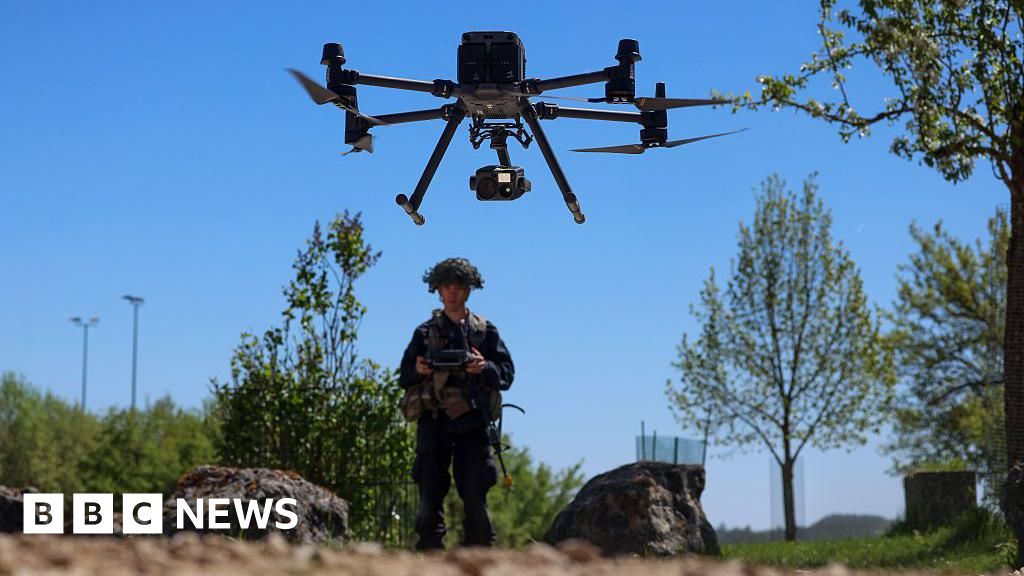
Cover image from bbc.com, which was analyzed for this article
President Trump announced plans to cut US troops in Germany 'way down' beyond initial withdrawals, alarming top Republicans who warn it sends the wrong signal to Russia. The move heightens concerns amid global tensions including the Iran war.
PoliticalOS
Sunday, May 3, 2026 — Politics
The Trump administration is accelerating a long-discussed reduction of U.S. forces in Germany as part of a larger strategic shift toward the Indo-Pacific, even as key Republicans worry it could embolden Moscow before European allies fully stand up new capabilities. Germany and NATO have responded with statements of preparedness and renewed calls for higher European spending, which is already rising. The single most important reality is that this is not a sudden abandonment but a continuation of policy tensions that predate the current Iran disputes: how much American blood and treasure should underwrite European security when those allies are finally increasing their own defense budgets.
What outlets missed
Both BBC and Newsmax underplayed the Pentagon's explicit rationale that the cuts stem from a formal review of shifting theater requirements, especially the long-term U.S. pivot toward containing China in the Indo-Pacific. The articles gave minimal attention to the fact that withdrawing 5,000 troops would return Germany levels close to those maintained before Russia's 2022 invasion of Ukraine, framing the move instead as either alarmingly abrupt or boldly punitive. Coverage also skimped on specifics about unaffected strategic assets such as Ramstein Air Base, which German officials described as irreplaceable for both nations, and offered little data on how Europe's recent defense spending surge (including Germany's projected 3.1 percent of GDP) might eventually offset the reductions. Finally, neither fully reconciled Trump's Iran-related grievances with the separate strategic case for reallocating forces away from a continent now spending more on its own security.
Trump Administration Cuts US Troops in Germany as Europe Faces Pressure to Fund Its Own Defense
The Pentagon is withdrawing 5,000 American troops from Germany, a move President Donald Trump said Saturday would be only the beginning of deeper reductions as Washington demands European allies shoulder more of the cost of their own security. The decision, announced Friday, comes amid ongoing transatlantic tensions that include a public dispute over Iran policy and new American tariffs on European vehicles, underscoring long-standing questions about whether the United States should continue subsidizing the defense of prosperous nations that spend comparatively little on their militaries.
Pentagon spokesman Sean Parnell described the cut as the result of a detailed review of theater requirements and conditions on the ground. The adjustment is expected to be completed over the next six to twelve months. As of the end of 2025, the United States maintained 36,436 active-duty troops in Germany, far more than the 12,662 in Italy or 3,814 in Spain. Trump told reporters he intends to go well beyond the initial 5,000, saying the United States is “going to cut way down, and we’re cutting a lot further than 5,000.” He offered no additional details.
The reduction arrives at a moment when Germany and other European states have increased defense budgets in response to Russia’s war in Ukraine. Yet the pattern of reliance on American power remains pronounced. For decades, many NATO members have treated the United States as a security blanket, allowing them to direct tax revenues toward expansive social programs while American taxpayers underwrote the alliance’s credible deterrent. This imbalance, long noted by fiscal conservatives, has produced a Europe that talks about strategic autonomy but continues to depend on Washington for the hard power that makes such talk possible.
Two senior Republicans who oversee military policy voiced sharp concern. Senate Armed Services Committee Chairman Roger Wicker and House Armed Services Committee Chairman Mike Rogers issued a joint statement Saturday warning that pulling a brigade from Germany risks undermining deterrence and sending the wrong signal to Vladimir Putin. They argued the troops should be repositioned farther east rather than withdrawn from the continent. “Prematurely reducing America’s forward presence in Europe before those capabilities are fully realised risks undermining deterrence,” the lawmakers wrote. They acknowledged that European allies are moving toward higher defense spending as a share of GDP but cautioned against drawing down before those commitments materialize.
Their unease was echoed, from the other side of the aisle, by Representative Adam Smith of Washington, the top Democrat on the House Armed Services Committee. Smith called the decision unmoored from any coherent national security strategy and suggested it stemmed from personal irritation rather than analysis.
German officials struck a different tone. Defense Minister Boris Pistorius told the DPA news agency that the American presence in Europe remains in Germany’s interest as well as America’s, but he added that some reduction “from Europe and also from Germany was to be expected.” Chancellor Friedrich Merz had earlier criticized American diplomacy with Iran, saying Tehran was “humiliating” Washington at the negotiating table, a remark that added to recent friction. NATO, for its part, said it was seeking clarification from Washington. Spokeswoman Allison Hart noted that the adjustment “underscores the need for Europe to continue to invest more in defense and take on a greater share of the responsibility for our shared security.”
The troop decision coincides with Trump’s announcement that tariffs on European cars and trucks will rise from 15 percent to 25 percent next week. The president accused the European Union of failing to honor a trade agreement signed last summer. These economic pressures, combined with the military drawdown, reflect a consistent view that alliances must rest on reciprocity. Nations with economies the size of Germany’s or France’s possess the resources to field credible forces. When they choose not to, they effectively ask American workers and families to tax themselves so Europeans can enjoy both generous welfare states and relative peace.
Critics of the reduction argue that any appearance of American retreat could embolden Moscow, especially while Russian forces remain engaged in Ukraine. Supporters counter that endless forward deployments without corresponding effort from allies create perverse incentives. If Europe truly fears Russian aggression, the logical response is to spend the necessary money on tanks, ammunition, and trained personnel rather than assume the United States will always fill the gap. Past experience shows that American patience with one-sided arrangements has limits. The current administration appears determined to test whether higher European defense budgets and more realistic burden-sharing can replace the old model of American guardianship.
How NATO navigates this transition will shape European security for years. The immediate risk is that political symbolism overtakes hard military reality. Moving 5,000 troops out of Germany does not eliminate America’s commitment to the continent, but it does signal that Washington intends to calibrate its presence according to what allies contribute. For years, economists and strategists have warned that perpetual free-riding erodes the political foundation of alliances. The troop adjustment and accompanying tariff increase may be an overdue attempt to restore that foundation on firmer ground of mutual obligation rather than one-sided subsidy.
Germany and its neighbors now face a practical choice. They can accelerate genuine defense investments that match their economic weight, or they can continue the familiar pattern of rhetoric without equivalent resources. The United States, for its part, is indicating that its willingness to carry disproportionate burdens is not infinite. The coming months will reveal whether this recalibration produces a stronger, more balanced NATO or merely exposes the gaps that decades of uneven spending have created.
You just read Conservative's take. Want to read what actually happened?
More in Politics

Trump Defends Ramaswamy Ad Using Estranged Mother in Ohio Race
President Trump defended a GOP nominee's ad featuring a Democratic opponent's estranged mother, calling it powerful, while drawing criticism from some Republicans including Ohio Gov. Mike DeWine. The ad has sparked internal GOP tensions ahead of midterms.
Federal Raid Targets Omar Amid Unresolved Name and Marriage Allegations
Agents searched Rep. Ilhan Omar's DC residence over immigration fraud allegations; she called it bizarre. Reports and commentary questioned her birth name and past marriage details.

Supreme Court Upholds New Hampshire Student ID Voting Ban
The Supreme Court upheld New Hampshire's ban on student IDs as valid voter identification just before midterms, affecting a tight Senate race.
Early Voting Hits 21 Million as Most Trust Midterm Accuracy
Millions have already voted early as parties make final appeals amid $1.4 billion in ad spending; polls show confidence in election accuracy.
The Compass
You just read five takes on one story.
What's your take? Find your political shape in a few minutes.
Take the test