
Tim Cook Steps Down as Apple CEO in September, John Ternus Named Successor
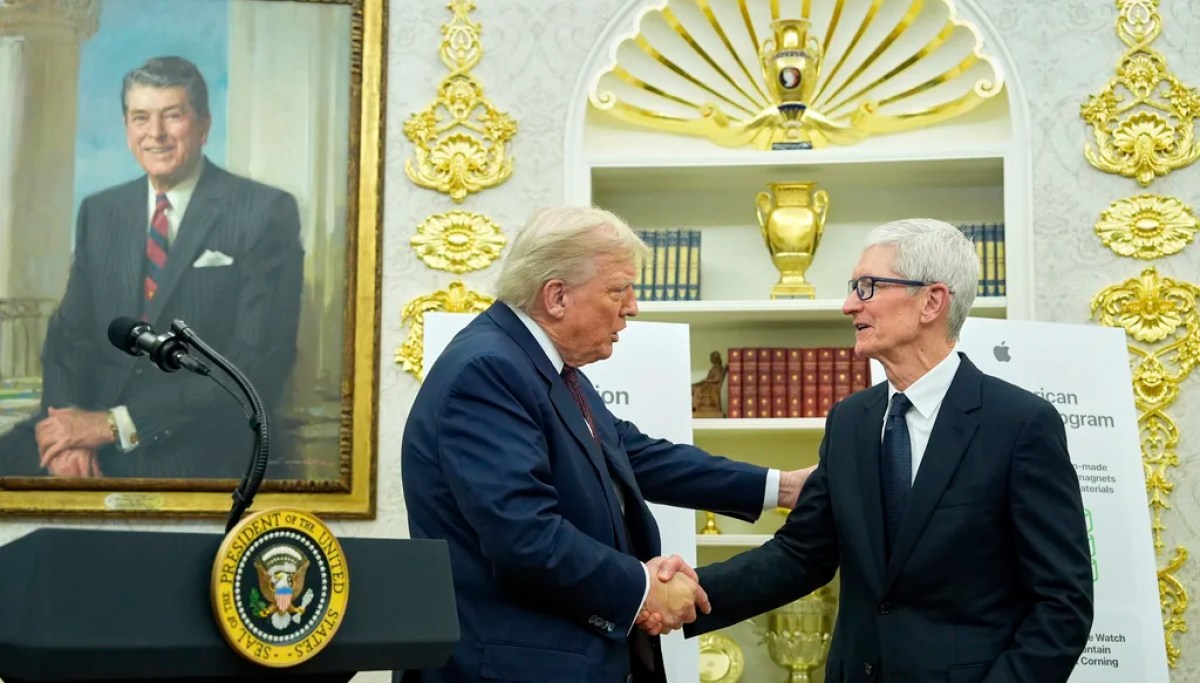
Cover image from washingtonexaminer.com, which was analyzed for this article
Tim Cook announced his departure as Apple CEO after 15 years, passing the baton to hardware engineering chief John Ternus as the company pivots toward AI advancements. The move drew reactions from tech leaders and Trump, who recalled Cook's past support. Investors eye Ternus's ability to sustain Apple's innovation amid competition.
PoliticalOS
Tuesday, April 21, 2026 — Tech
Apple's board planned this succession over time to maintain stability while positioning a hardware expert to drive the next innovation cycle in AI-integrated devices. Cook leaves behind unprecedented scale and financial success, yet the company must still prove it can deliver a breakout product beyond the iPhone amid fast-moving competition. The modest market reaction and praise from figures across tech and politics suggest confidence in Ternus's ability to sustain momentum, but execution over the coming years will determine whether deliberate pacing becomes Apple's advantage or its vulnerability.
What outlets missed
Most outlets underplayed or omitted the board's unanimous approval after long-term planning, Cook's explicit ongoing role assisting with global policymakers as executive chairman, and the precise September 1, 2026 effective date that underscores continuity rather than abrupt change. Few noted specific positive analyst language such as Wedbush calling it a 'model succession' or quantified services growth to $28.8 billion in a recent quarter alongside the 2,300 percent stock rise cited by some. Trump's post referenced concrete past assistance including tariff waivers on Mac Pros and Apple's $430 billion U.S. investment pledges, details that add policy context but appeared only in fragmented form. Apple's on-device AI approach since 2017 and recent iPhone revenue surge of 23 percent to $85.3 billion were mentioned unevenly, leaving readers without full picture of current financial strength amid AI questions.
Apple Names John Ternus Chief Executive in Calculated Shift at Market-Leading Innovator
Apple announced Monday that John Ternus will succeed Tim Cook as chief executive on September 1, with Cook transitioning to executive chairman after 15 years at the helm. The move caps a remarkable run for Cook, during which the company created enormous value for shareholders through disciplined operations, product expansion, and an unrelenting focus on execution rather than hype. Ternus, a 25-year Apple veteran who has overseen hardware engineering, emerges as the choice to steer the company through intensifying competition and technological change.
Cook assumed leadership in 2011 after Steve Jobs stepped down for health reasons. What followed was one of the great runs in American business history. Apple's market value climbed from roughly $350 billion to more than $4 trillion. The stock rose more than 2,000 percent. The company became the first to reach $1 trillion in valuation in 2018 and later hit the $4 trillion mark. Under Cook, Apple extended the iPhone's dominance while layering on the Apple Watch, AirPods, and a services business that generates reliable recurring revenue. These were not flashy disruptions but refinements and extensions of existing strengths, delivered with supply-chain mastery that few organizations have matched.
Cook himself described the role as the greatest privilege of his life. In a statement, he called Ternus a visionary with the mind of an engineer, the soul of an innovator, and the character to lead with integrity. Ternus has touched nearly every major product during his tenure, from successive iPhone generations to the pivotal transition to Apple-designed silicon. That 2020 shift away from Intel processors proved decisive. It gave Apple tighter control over performance, efficiency, and features while reducing dependence on external suppliers. The move exemplified the kind of patient, technically grounded decision-making that rewards long-term thinking over quarterly applause.
Ternus's promotion signals continuity in Apple's product-oriented culture. Unlike leaders who rose through sales or finance, he has spent his career close to the hardware that customers actually hold and use. Former colleagues describe him as collaborative and unpretentious, someone who declined a private office upon promotion so he could remain with his team. At 50, he bridges the Jobs and Cook eras, having joined the company in 2001 shortly after the iPod's debut. His public profile has grown in recent years as he presented new Macs and the iPhone Air. Promoting Johny Srouji, the architect of Apple's custom chips, to chief hardware officer further reinforces the company's engineering-first orientation.
Yet the transition occurs amid clear challenges. Apple has watched competitors pour hundreds of billions into artificial intelligence infrastructure while largely avoiding such capital-intensive bets. The company's Apple Intelligence features, unveiled with ambitious claims about on-device processing and privacy, have encountered delays. A revamped Siri powered in part by Google's Gemini is expected later this year. Investors increasingly want evidence that Apple can fuse its hardware expertise with practical AI capabilities that justify premium pricing without compromising the privacy stance that has become a competitive differentiator.
The post-iPhone question also lingers. Cook extended the device's success into wearables and services, but efforts in autonomous vehicles were shelved before reaching market and the Vision Pro mixed-reality headset has found limited buyers at its current price. These outcomes illustrate the difficulty of creating entirely new product categories even for a company with Apple's resources and discipline. History shows that genuine breakthroughs often arise from decentralized trial and error rather than top-down pronouncements, a reality that applies as much to technology as to other complex systems.
External pressures compound the task. Supply chains remain entangled in geopolitical tensions, particularly with manufacturing concentrated in China. The incoming Trump administration has signaled renewed emphasis on reshoring production, an area where Cook's policymaker relationships proved useful. In a Truth Social post, President Trump recalled fielding calls from Cook during his first term, describing how the executive sought help with a significant problem that only the president could address. Trump said he delivered results quickly and later praised Cook's management ability, though his colorful recollection of the initial outreach underscored the transactional nature of high-level government-business dealings. Such relationships highlight both the necessity of competent engagement with regulators and the risks when success hinges partly on political access.
For Ternus, the mandate is clear: sustain the operational excellence that multiplied Apple's value while finding the next genuine advance that serves customers rather than chasing trends. Wall Street analysts note the stock's forward price-to-earnings multiple has expanded significantly under Cook, reflecting high expectations. Meeting them will require the same respect for empirical feedback and incremental improvement that characterized Apple's best periods.
Cook's departure is not the end of an era but a handoff within one. The company he leaves is a testament to what focused private enterprise can achieve when it prioritizes useful products, efficient production, and long time horizons over fashionable causes or subsidized bets. Whether Ternus can ignite the next wave of organic growth will test whether that culture remains as potent in the face of AI enthusiasm, trade frictions, and the perpetual difficulty of predicting consumer desires. Markets have rewarded Apple's realism before. They will judge the next chapter by the same standard.
You just read Conservative's take. Want to read what actually happened?
More in Technology
Trump Pushes Community Dividends to Ease Data Center Backlash
Trump suggested tech companies pay local communities a 'dividend' to gain support for massive AI data centers amid growing backlash over energy use and infrastructure.
Musk Pledges One SpaceX Share to Every U.S. Child
Musk announced plans to distribute one SpaceX share to each of roughly 73 million American children next year, drawing praise from Trump and signaling closer alignment between the two.

Trump Administration Bans DeepSeek AI From Federal Civilian Agencies
Tech stocks rebounded on AI optimism while hyperscalers and firms navigate data center infrastructure, earnings focus, and regulatory scrutiny including bans on certain Chinese AI tools.

Musk Says He Will Give One SpaceX Share to Every US Child
Elon Musk announced plans to distribute one SpaceX share to every American child in 2027, with hints of further giveaways. The pledge drew coverage across outlets amid broader discussions of AI philanthropy and Musk entities.
The Compass
You just read five takes on one story.
What's your take? Find your political shape in a few minutes.
Take the test