
Tim Cook Steps Down as Apple CEO in September, John Ternus Named Successor
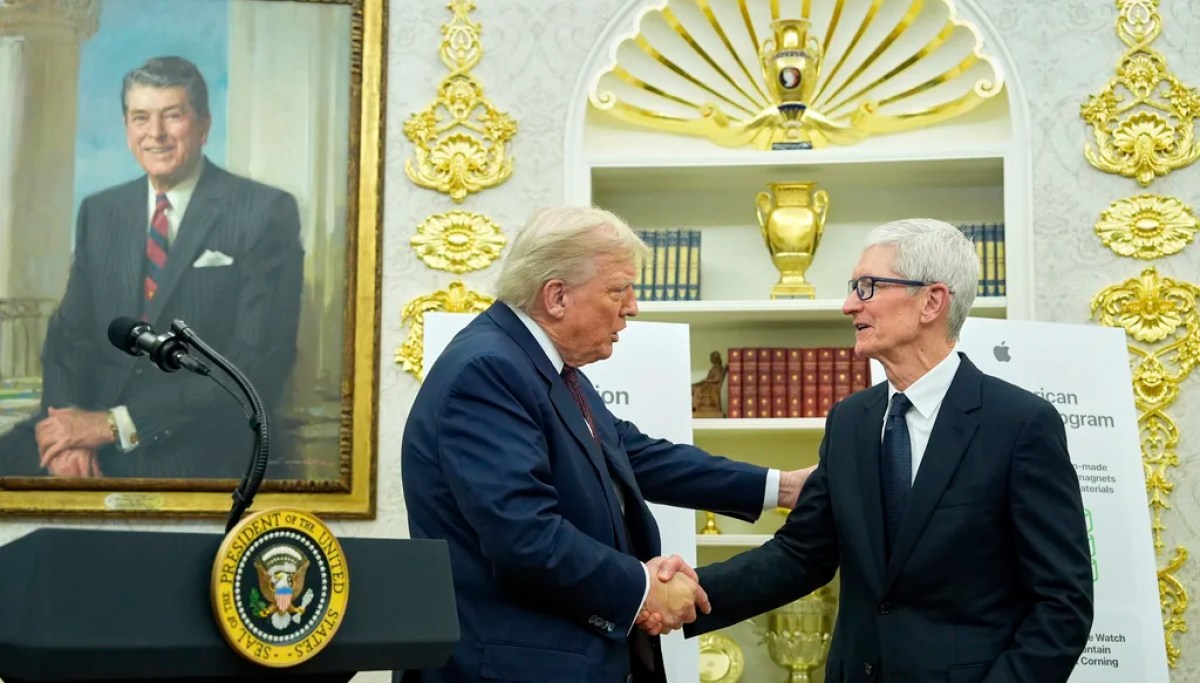
Cover image from washingtonexaminer.com, which was analyzed for this article
Tim Cook announced his departure as Apple CEO after 15 years, passing the baton to hardware engineering chief John Ternus as the company pivots toward AI advancements. The move drew reactions from tech leaders and Trump, who recalled Cook's past support. Investors eye Ternus's ability to sustain Apple's innovation amid competition.
PoliticalOS
Tuesday, April 21, 2026 — Tech
Apple's board planned this succession over time to maintain stability while positioning a hardware expert to drive the next innovation cycle in AI-integrated devices. Cook leaves behind unprecedented scale and financial success, yet the company must still prove it can deliver a breakout product beyond the iPhone amid fast-moving competition. The modest market reaction and praise from figures across tech and politics suggest confidence in Ternus's ability to sustain momentum, but execution over the coming years will determine whether deliberate pacing becomes Apple's advantage or its vulnerability.
What outlets missed
Most outlets underplayed or omitted the board's unanimous approval after long-term planning, Cook's explicit ongoing role assisting with global policymakers as executive chairman, and the precise September 1, 2026 effective date that underscores continuity rather than abrupt change. Few noted specific positive analyst language such as Wedbush calling it a 'model succession' or quantified services growth to $28.8 billion in a recent quarter alongside the 2,300 percent stock rise cited by some. Trump's post referenced concrete past assistance including tariff waivers on Mac Pros and Apple's $430 billion U.S. investment pledges, details that add policy context but appeared only in fragmented form. Apple's on-device AI approach since 2017 and recent iPhone revenue surge of 23 percent to $85.3 billion were mentioned unevenly, leaving readers without full picture of current financial strength amid AI questions.
Apple Taps Insider as CEO While Tech Giant Confronts China Dependence and AI Stumbles
Apple announced Monday that John Ternus will become chief executive on September 1, ending Tim Cook's 15-year reign at the world's most recognizable technology company. Cook, who took over after Steve Jobs's death in 2011, will shift to executive chairman. The move had been telegraphed for months, but it arrives at a moment when Apple's extraordinary financial success masks deeper vulnerabilities that affect American workers, national security, and the company's long-term relevance.
Ternus, 50, has spent 25 years inside Apple, rising through the hardware engineering ranks. He played a central role in the transition to Apple-designed chips that replaced Intel processors in Macs, helped roll out successive iPhone generations, and became a familiar face onstage during product launches. Supporters describe him as a genuine product thinker rather than a pure operations man like Cook. Yet his entire career has unfolded within the same corporate culture that moved vast amounts of production to China. Nothing in his record suggests he will suddenly challenge the assumptions that made that offshoring profitable.
Cook leaves behind a company valued at roughly $4 trillion, up from about $350 billion when he started. The stock soared more than 2,000 percent. Apple became the first trillion-dollar public company under his watch, built a lucrative services division, and expanded wearables with the Apple Watch and AirPods. These are real achievements. But they also paper over what Apple failed to do. The company never delivered a true successor to the iPhone. Its autonomous car project was quietly killed. The Vision Pro mixed-reality headset remains a high-priced curiosity that few people actually buy. And on artificial intelligence, Apple has spent years talking a better game than it has delivered.
That lag is now glaring. While Microsoft, Google, and others poured hundreds of billions into data centers and custom AI chips, Apple largely sat on the sidelines to protect margins. Its Apple Intelligence features have been repeatedly delayed. The company struck a deal to license Google's Gemini model rather than build its own foundational technology. Incoming CEO Ternus now inherits the pressure to close that gap without blowing up the cost structure that has made Apple a cash machine. Wall Street analysts openly wonder whether he will accelerate spending on American-based infrastructure or continue the cautious approach that kept factories overseas.
President Trump offered a blunt reminder of how Cook operated in Washington. In a Truth Social post, Trump recalled Cook calling him directly for help with a "fairly large" problem that only the president could fix. "Most people would have paid millions of dollars to a consultant," Trump wrote. "When I got the call I said, wow, it’s Tim Apple calling." Trump said he delivered the help quickly, then watched Cook praise his management skills. The anecdote captures the reality of how multinational corporations interact with political power. Cook was exceptionally skilled at managing regulators, tariffs, and supply-chain crises. He cultivated relationships across administrations while keeping Apple's manufacturing overwhelmingly in China, where labor costs and government subsidies delivered handsome profits.
Those profits came at a cost to American communities that once built electronics. The same pattern repeats across Big Tech. Executives fly to Washington for favorable treatment, lecture Americans about democracy, then depend on a rival authoritarian state for production. Geopolitical tensions, potential tariffs, and rising memory-chip prices tied to the global AI buildout are now complicating that model. Apple lost its crown as the world's most valuable company to Nvidia, the American firm actually making the silicon that powers the AI revolution.
Ternus will also have to navigate an executive bench that is showing signs of strain. The promotion of chip architect Johny Srouji to chief hardware officer may be an attempt to keep talent from leaving. For all the praise Cook receives for execution and logistics, his departure leaves Apple chasing the next hit in a market that no longer rewards incremental iPhone upgrades the way it once did.
The succession is being sold as a smooth handoff to a visionary insider. But the real test is whether Ternus can break from the habits that made Apple enormously rich yet increasingly disconnected from the American industrial base that once supported it. Cook mastered the art of optimizing a global supply chain that prioritized efficiency over resilience. The question now is whether his successor recognizes that the world has changed, that voters have changed, and that depending on China for critical technology carries risks no amount of polished marketing can erase. For a company that likes to portray itself as uniquely forward-thinking, Apple finds itself reacting to events rather than shaping them. The post-Cook era begins with the same uncomfortable facts the last one never fully resolved.
You just read America First's take. Want to read what actually happened?
More in Technology
Trump Pushes Community Dividends to Ease Data Center Backlash
Trump suggested tech companies pay local communities a 'dividend' to gain support for massive AI data centers amid growing backlash over energy use and infrastructure.
Musk Pledges One SpaceX Share to Every U.S. Child
Musk announced plans to distribute one SpaceX share to each of roughly 73 million American children next year, drawing praise from Trump and signaling closer alignment between the two.

Trump Administration Bans DeepSeek AI From Federal Civilian Agencies
Tech stocks rebounded on AI optimism while hyperscalers and firms navigate data center infrastructure, earnings focus, and regulatory scrutiny including bans on certain Chinese AI tools.

Musk Says He Will Give One SpaceX Share to Every US Child
Elon Musk announced plans to distribute one SpaceX share to every American child in 2027, with hints of further giveaways. The pledge drew coverage across outlets amid broader discussions of AI philanthropy and Musk entities.
The Compass
You just read five takes on one story.
What's your take? Find your political shape in a few minutes.
Take the test