
Tim Cook Steps Down as Apple CEO in September, John Ternus Named Successor
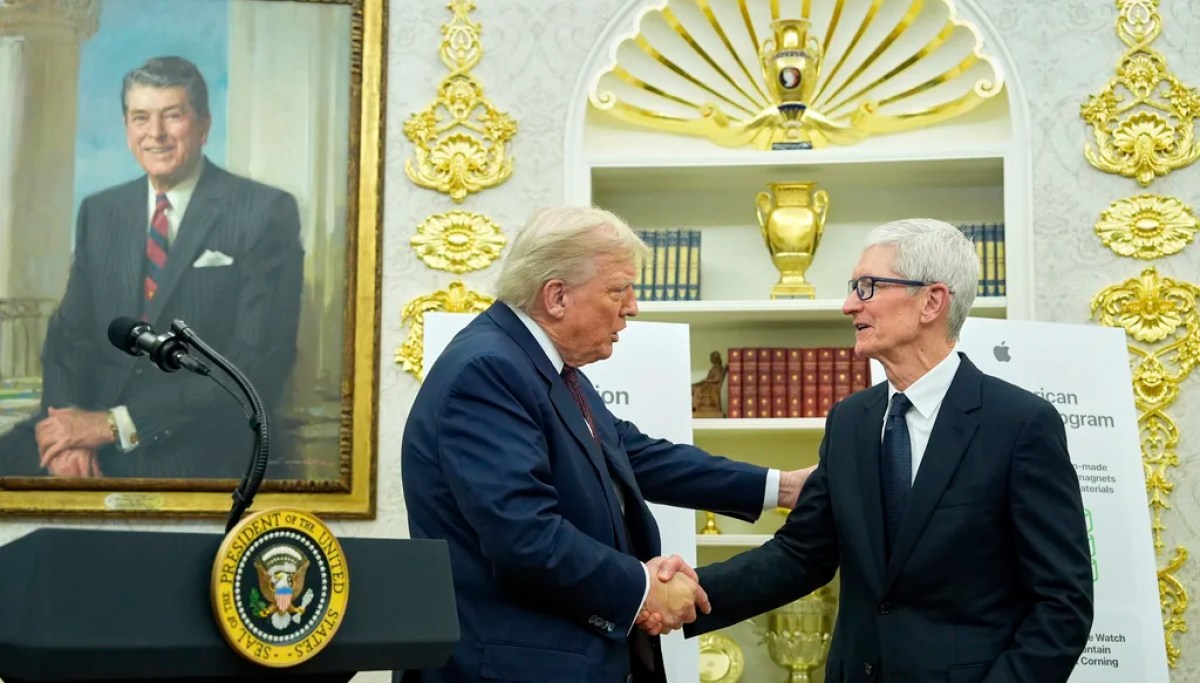
Cover image from washingtonexaminer.com, which was analyzed for this article
Tim Cook announced his departure as Apple CEO after 15 years, passing the baton to hardware engineering chief John Ternus as the company pivots toward AI advancements. The move drew reactions from tech leaders and Trump, who recalled Cook's past support. Investors eye Ternus's ability to sustain Apple's innovation amid competition.
PoliticalOS
Tuesday, April 21, 2026 — Tech
Apple's board planned this succession over time to maintain stability while positioning a hardware expert to drive the next innovation cycle in AI-integrated devices. Cook leaves behind unprecedented scale and financial success, yet the company must still prove it can deliver a breakout product beyond the iPhone amid fast-moving competition. The modest market reaction and praise from figures across tech and politics suggest confidence in Ternus's ability to sustain momentum, but execution over the coming years will determine whether deliberate pacing becomes Apple's advantage or its vulnerability.
What outlets missed
Most outlets underplayed or omitted the board's unanimous approval after long-term planning, Cook's explicit ongoing role assisting with global policymakers as executive chairman, and the precise September 1, 2026 effective date that underscores continuity rather than abrupt change. Few noted specific positive analyst language such as Wedbush calling it a 'model succession' or quantified services growth to $28.8 billion in a recent quarter alongside the 2,300 percent stock rise cited by some. Trump's post referenced concrete past assistance including tariff waivers on Mac Pros and Apple's $430 billion U.S. investment pledges, details that add policy context but appeared only in fragmented form. Apple's on-device AI approach since 2017 and recent iPhone revenue surge of 23 percent to $85.3 billion were mentioned unevenly, leaving readers without full picture of current financial strength amid AI questions.
Apple Names John Ternus Chief Executive as Company Confronts Limits of Its Post-iPhone Era
Apple announced Monday that John Ternus will become chief executive on September 1, succeeding Tim Cook after a 15-year tenure that turned the company into one of the most valuable enterprises in history. Cook, who will transition to executive chairman, oversaw explosive growth that saw Apple's market value rise from roughly $350 billion when he took over in 2011 to more than $4 trillion today. The stock itself climbed more than 2,000 percent. Yet the leadership change arrives at a moment when the company's formula of relentless iteration on existing hits faces genuine questions about its ability to chart the next phase of technological progress.
Ternus, 50, has spent 25 years at Apple and currently leads hardware engineering. He played a central role in nearly every major product launch of the modern era, from successive iPhone generations to the transition to Apple-designed chips that revived the Mac lineup beginning in 2020. Colleagues describe him as a detail-oriented product leader who rose quickly after joining the company in 2001, preferring to sit with his team rather than move into a private office when first promoted. His elevation continues a pattern of promoting from within, a hallmark of Apple's insular culture. The company also promoted Johny Srouji, the architect of its custom silicon strategy, to chief hardware officer, a move that appears designed to retain one of its most important technical minds.
Cook's record is in many ways extraordinary. He inherited a company defined by the singular genius of Steve Jobs and proved that operational excellence could scale what Jobs created. The Apple Watch and AirPods became significant businesses. Services revenue exploded into a high-margin annuity. Cook deepened Apple's presence in China while managing the complex, often tense relationship between Beijing and Washington. He steered the firm through supply-chain crises, a global pandemic, and repeated antitrust scrutiny. By almost any financial metric, the Cook era has been an unqualified success.
Yet the sources of that success also illuminate the challenges Ternus inherits. Apple's dominance still rests overwhelmingly on the iPhone, a product now more than 18 years old. Efforts to break into new categories have produced mixed results at best. The autonomous vehicle project was canceled before reaching the market. The Vision Pro mixed-reality headset, priced at several thousand dollars, has found few buyers. Even the company's careful approach to artificial intelligence, which emphasizes on-device processing and privacy, has left it appearing reactive rather than leading the industry conversation.
That positioning has consequences. While Microsoft, Google, Amazon, and Meta have committed hundreds of billions of dollars to build out AI infrastructure, Apple has avoided massive capital expenditures on data centers and foundational models. It has instead partnered with Google to use the Gemini model for key features, including a long-delayed upgrade to Siri expected later this year. Investors have taken notice. Apple recently lost its title as the world's most valuable company to Nvidia, the chipmaker at the center of the AI boom. Wall Street analysts now frame the leadership transition as a test of whether Ternus can fuse the company's deep hardware expertise with more ambitious AI development without abandoning the privacy principles that have long distinguished Apple.
The external environment adds further complexity. Ternus will confront an American political landscape increasingly focused on domestic manufacturing and skeptical of China's role in technology supply chains. Cook was known for his deft navigation of Washington, cultivating relationships across administrations. Former President Trump, in a social media post reacting to the news, recalled Cook seeking presidential intervention for a significant business problem and described the interaction in characteristically blunt terms. The incoming administration has signaled renewed interest in tariffs and onshoring production, issues that directly affect Apple's intricate global assembly lines.
These pressures arrive as the broader technology industry grapples with the societal implications of rapidly advancing AI. Apple's deliberate pace has been framed internally as responsible stewardship, avoiding the hype cycles and potential harms that have accompanied generative tools elsewhere. Yet that same caution risks ceding ground in defining how AI integrates into everyday devices used by billions of people. Ternus's background suggests a focus on tight integration between hardware and software, the formula that made Apple Silicon so successful. The question is whether that product-oriented approach can generate the breakthrough category the company has lacked since the iPhone, or whether the economic and regulatory forces now shaping technology will demand a more fundamental rethinking of Apple's role.
For all the attention on who will occupy the chief executive's office, the deeper transition may be cultural and strategic. Cook professionalized Apple, turning it from a creative insurgency into a logistics and finance powerhouse with an unparalleled balance sheet. Ternus represents a return to visible product leadership after an operations-focused interregnum. His success will be measured not simply by revenue growth but by whether Apple can once again shape the future of personal computing rather than refine its past successes.
The announcement comes months after Apple celebrated its 50th anniversary, a milestone that invites reflection on how a company once defined by rebellion against the corporate status quo now sits at the center of global economic and technological power. Ternus takes over at a time when that power faces new tests from both competition and regulation, from geopolitics and public expectations about technology's role in society. Cook's letter to employees called the job the greatest privilege of his life. The privilege now passes to a leader whose task is to prove that Apple's remarkable run can be extended through another era of profound technological change.
You just read Liberal's take. Want to read what actually happened?
More in Technology
Trump Pushes Community Dividends to Ease Data Center Backlash
Trump suggested tech companies pay local communities a 'dividend' to gain support for massive AI data centers amid growing backlash over energy use and infrastructure.
Musk Pledges One SpaceX Share to Every U.S. Child
Musk announced plans to distribute one SpaceX share to each of roughly 73 million American children next year, drawing praise from Trump and signaling closer alignment between the two.

Trump Administration Bans DeepSeek AI From Federal Civilian Agencies
Tech stocks rebounded on AI optimism while hyperscalers and firms navigate data center infrastructure, earnings focus, and regulatory scrutiny including bans on certain Chinese AI tools.

Musk Says He Will Give One SpaceX Share to Every US Child
Elon Musk announced plans to distribute one SpaceX share to every American child in 2027, with hints of further giveaways. The pledge drew coverage across outlets amid broader discussions of AI philanthropy and Musk entities.
The Compass
You just read five takes on one story.
What's your take? Find your political shape in a few minutes.
Take the test