
Tim Cook Steps Down as Apple CEO in September, John Ternus Named Successor
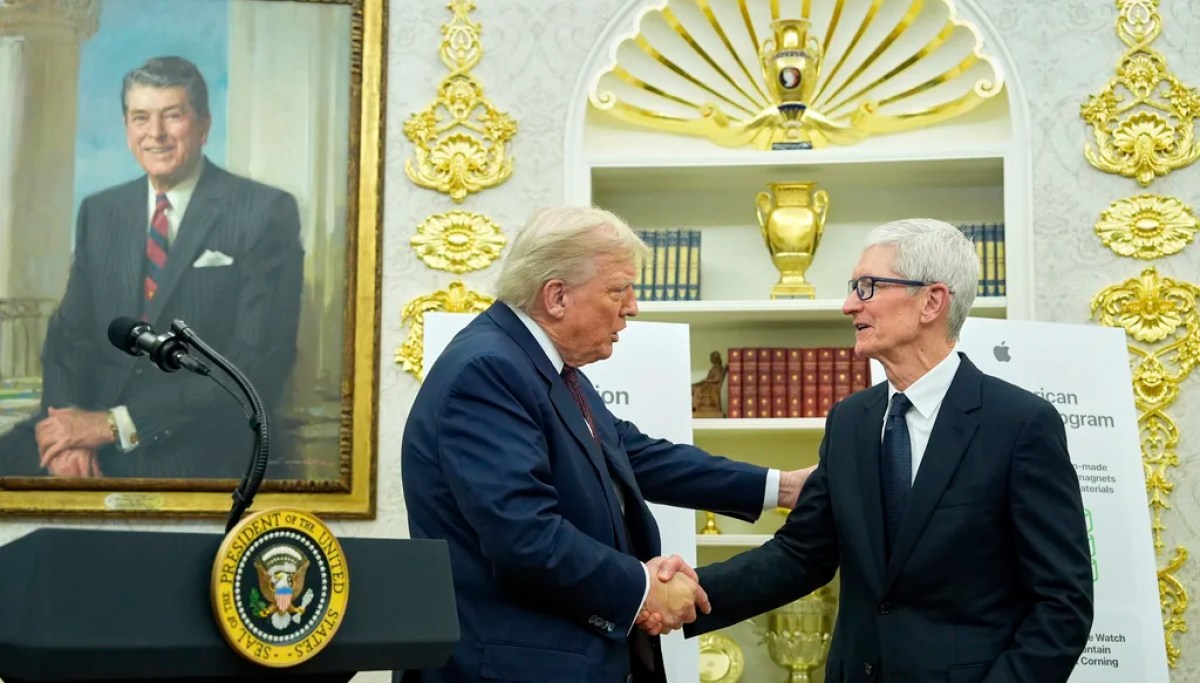
Cover image from washingtonexaminer.com, which was analyzed for this article
Tim Cook announced his departure as Apple CEO after 15 years, passing the baton to hardware engineering chief John Ternus as the company pivots toward AI advancements. The move drew reactions from tech leaders and Trump, who recalled Cook's past support. Investors eye Ternus's ability to sustain Apple's innovation amid competition.
PoliticalOS
Tuesday, April 21, 2026 — Tech
Apple's board planned this succession over time to maintain stability while positioning a hardware expert to drive the next innovation cycle in AI-integrated devices. Cook leaves behind unprecedented scale and financial success, yet the company must still prove it can deliver a breakout product beyond the iPhone amid fast-moving competition. The modest market reaction and praise from figures across tech and politics suggest confidence in Ternus's ability to sustain momentum, but execution over the coming years will determine whether deliberate pacing becomes Apple's advantage or its vulnerability.
What outlets missed
Most outlets underplayed or omitted the board's unanimous approval after long-term planning, Cook's explicit ongoing role assisting with global policymakers as executive chairman, and the precise September 1, 2026 effective date that underscores continuity rather than abrupt change. Few noted specific positive analyst language such as Wedbush calling it a 'model succession' or quantified services growth to $28.8 billion in a recent quarter alongside the 2,300 percent stock rise cited by some. Trump's post referenced concrete past assistance including tariff waivers on Mac Pros and Apple's $430 billion U.S. investment pledges, details that add policy context but appeared only in fragmented form. Apple's on-device AI approach since 2017 and recent iPhone revenue surge of 23 percent to $85.3 billion were mentioned unevenly, leaving readers without full picture of current financial strength amid AI questions.
Apple Names John Ternus CEO as Tim Cook Era Ends With AI Questions Looming
Apple announced Monday that John Ternus will succeed Tim Cook as chief executive on September 1, ending a 15-year run in which Cook transformed the company into a $4 trillion behemoth while leaving his successor to confront a stubborn reality: the iPhone maker has yet to deliver a breakout product for the artificial intelligence age.
Ternus, 50, has spent a quarter-century at Apple, rising from the product design team he joined in 2001 to senior vice president of hardware engineering. He played a central role in virtually every major device launch, from successive iPhone generations to the transition to Apple-designed silicon that upended the Mac lineup beginning in 2020. Colleagues describe him as a detail-oriented engineer who prefers sitting with his teams rather than retreating behind closed doors. Cook, who will shift to executive chairman, called Ternus “a visionary” with “the mind of an engineer, the soul of an innovator and the heart to lead with integrity and honour.”
The move had been telegraphed for months. Cook, who took over in 2011 after Steve Jobs’s resignation, oversaw explosive growth. Apple’s market value rose from roughly $350 billion to more than $4 trillion. Its stock climbed more than 2,000 percent. The company became the first to reach $1 trillion, then $2 trillion, then $3 trillion. Services revenue exploded, the Apple Watch and AirPods extended the iPhone’s gravitational pull, and manufacturing discipline turned Cupertino into one of the most profitable enterprises on earth.
Yet the Cook legacy also includes notable stumbles. The autonomous car project was canceled before reaching market. The Vision Pro mixed-reality headset remains a high-priced niche product with limited appeal. And on artificial intelligence, Apple has moved cautiously while rivals poured hundreds of billions of dollars into data centers and proprietary models. Apple Intelligence, unveiled with fanfare in 2024, has seen its most ambitious features repeatedly delayed. A revamped Siri powered in part by Google’s Gemini is expected later this year, but the company has so far avoided the massive capital expenditures that define the AI race at Microsoft, Google, Meta and Amazon.
That caution now becomes Ternus’s problem. Investors have grown impatient. Apple recently lost its crown as the world’s most valuable company to Nvidia, the chipmaker fueling the AI boom. Wall Street analysts say the new CEO must demonstrate whether Apple’s deep hardware expertise can be fused with credible AI offerings or whether the company will remain content to let others set the pace. Ternus’s promotion of Johny Srouji, the architect of Apple’s custom chips, to chief hardware officer suggests continuity in silicon design, but it does little to answer questions about foundational models or cloud-scale computing.
The leadership change also arrives at a delicate political moment. Cook was renowned for his ability to manage relationships in Washington and Beijing. He cultivated ties across administrations, a skill that drew blunt praise from Donald Trump on Tuesday. In a Truth Social post, the president recalled Cook calling him for help with “a fairly large problem that only I, as President, could fix.” Trump described the Apple chief as someone who “would call me, but never too much,” and boasted that after providing “3 or 4 BIG HELPS,” he began telling people Cook was “an amazing manager and leader.” The language was vintage Trump, framing a business relationship in personal, transactional terms. The anecdote underscored how even the most powerful corporation in the world still needs political cover, whether on tariffs, supply chains or regulatory pressure.
Ternus inherits those same geopolitical tensions. The Trump administration is expected to push for more manufacturing to return to the United States, complicating Apple’s intricate and China-dependent supply chain. Memory prices are rising because of AI-driven demand. Trade policy, export controls and the constant threat of tariffs will test whether the new CEO possesses Cook’s deft touch with policymakers, a role Cook will reportedly continue to support in his chairman position.
For all the focus on AI, the deeper question is whether Apple can still invent the future. Under Cook the company perfected execution and ecosystem lock-in. It maximized the iPhone era rather than transcending it. Ternus, described by those who worked with him as a “product guy” in the mold of the Jobs years, may bring fresh emphasis on hardware innovation. Yet the structural challenges remain: an industry shifting toward software intelligence, mounting competition from leaner AI-first rivals, and a public increasingly skeptical of trillion-dollar corporations that extract enormous profits while delivering incremental upgrades.
Cook described his time as CEO as “the greatest privilege of my life.” He leaves a company richer and more powerful than at any point in its history. Whether that power translates into meaningful technological leaps under Ternus, or simply more refined ways to monetize the existing empire, will define the next chapter. For now, Apple enters the post-Cook era still chasing its next truly transformative hit, at a moment when the entire technology industry is being remade around artificial intelligence. The hardware engineer who helped build the machines must now prove he can rewire the company’s ambitions for the software-defined future.
You just read Progressive's take. Want to read what actually happened?
More in Technology
Trump Pushes Community Dividends to Ease Data Center Backlash
Trump suggested tech companies pay local communities a 'dividend' to gain support for massive AI data centers amid growing backlash over energy use and infrastructure.
Musk Pledges One SpaceX Share to Every U.S. Child
Musk announced plans to distribute one SpaceX share to each of roughly 73 million American children next year, drawing praise from Trump and signaling closer alignment between the two.

Trump Administration Bans DeepSeek AI From Federal Civilian Agencies
Tech stocks rebounded on AI optimism while hyperscalers and firms navigate data center infrastructure, earnings focus, and regulatory scrutiny including bans on certain Chinese AI tools.

Musk Says He Will Give One SpaceX Share to Every US Child
Elon Musk announced plans to distribute one SpaceX share to every American child in 2027, with hints of further giveaways. The pledge drew coverage across outlets amid broader discussions of AI philanthropy and Musk entities.
The Compass
You just read five takes on one story.
What's your take? Find your political shape in a few minutes.
Take the test