
California Candidates Clash on Taxes, Homelessness in Volatile Debate
Cover image from theguardian.com, which was analyzed for this article
Top candidates for California governor sparred on key issues in a pivotal debate after Eric Swalwell's exit, highlighting strategies in the topsy-turvy race. Coverage focuses on policy differences and frontrunners' performances. Republicans and Democrats position for advantage.
PoliticalOS
Thursday, April 23, 2026 — Politics
California's top-two primary has created a rare opening for Republicans to reach the general election if the large Democratic field fragments the vote, yet the debate showed no candidate delivered a decisive advantage. Substantive differences over taxes, homelessness spending and whether identity or practicality should drive policy remain the real stakes. Voters should weigh the candidates' records and specific proposals rather than performative moments or unverified personal attacks.
What outlets missed
Most coverage omitted the 2025 statewide point-in-time count showing a 9 percent drop in unsheltered homelessness, the first decline in more than 15 years, which could have contextualized Democratic defenses of Newsom's record. Outlets also underplayed Mahan's discussion of regulating artificial intelligence, an issue he tied to his Silicon Valley mayoral experience and which received only glancing treatment. Bianco's recent seizure of more than 500,000 ballots from a prior election, halted by the state supreme court, drew minimal follow-up despite his onstage defense that it was a routine inquiry into election security. Finally, federal Department of Transportation pressure on California's commercial driver licensing standards for non-English speakers, documented by LAist in 2025, provided independent backing for Bianco's truck-safety argument but was rarely linked beyond the immediate exchange.
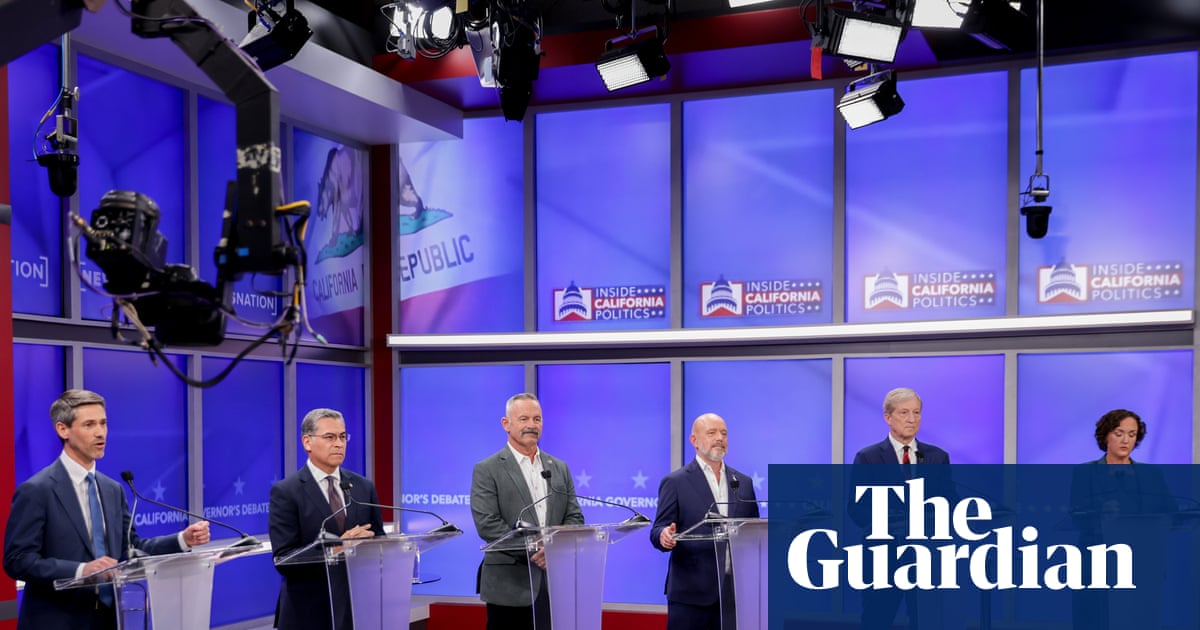
Ballots drop in early May for California's June 2 primary, and the state's next governor will inherit crushing housing costs, persistent homelessness and the highest cost of living in the nation. Wednesday night's debate among six contenders offered the clearest look yet at how starkly their prescriptions diverge. With no breakout performance and roughly one in four voters still undecided, the central tension remains unresolved: can a fragmented Democratic field hand the top two primary spots to Republicans Steve Hilton and Chad Bianco, or will Democrats consolidate in time to preserve one-party control?
The 90-minute Nexstar broadcast from KRON studios in San Francisco came days after Eric Swalwell quit the race amid sexual assault allegations he denies. Organizers had expanded the stage after a follow-up poll showed San Jose Mayor Matt Mahan and former HHS Secretary Xavier Becerra clearing the threshold. Moderators drilled candidates on affordability, gas prices, insurance and homelessness. Republicans repeatedly tied those problems to 16 years of uninterrupted Democratic governance. Hilton, a former Fox News host endorsed by President Trump according to multiple campaign statements, called Democratic tax policy an "insatiable appetite for more and more taxes for their bottomless money pit." He pledged to halve the state's 61-cent gas tax and bring prices down toward $3 a gallon.
Democrats largely defended Gov. Gavin Newsom's record while jostling among themselves. On homelessness grades, Becerra gave Newsom an A for effort. Porter, a former congresswoman, awarded a B and cited her background as a single mother tracking grocery bills. Steyer, the billionaire hedge-fund founder who has poured more than $100 million of his own money into the campaign per his own disclosures, offered a B-minus. Mahan settled on a D for "all of us." Both Republicans awarded F grades. Bianco, the Riverside County sheriff, said the state has spent billions with little to show.
Exchanges grew sharpest on race and regulation. Porter pressed Bianco on truck-driver language requirements, suggesting the policy profiled Black, brown and immigrant drivers. Bianco replied that Californians "are sick and tired of our politicians making race the basis of everything" and insisted the rule prevents fatal crashes by drivers unable to read signs. The moment, captured in multiple broadcast clips, crystallized the Republican argument that identity politics has crowded out practical governance. Federal Department of Transportation scrutiny of California's commercial licensing practices, reported by LAist in 2025, lent context to Bianco's position though exact linkage to the debate was not restated onstage.
Democrats trained much of their fire on Steyer's wealth and past investments. Mahan charged that "the only housing Tom Steyer's built has been private prisons and ICE detention centers," referencing Steyer's earlier hedge-fund stakes in Corrections Corporation of America. Steyer responded that he is "the billionaire who wants to tax other billionaires" and plans to give away most of his fortune. He also reminded viewers that other billionaires and corporations are funding opposition. Becerra, who has seen his support rise since Swalwell's exit according to Emerson and PPIC polling, attacked Hilton as an inexperienced "talking head" who never ran government. Hilton countered by highlighting federal partnerships possible under a Trump-aligned governor.
Bianco went further than Hilton on the primary outcome. Asked whether he would support the eventual nominee of his party, Bianco predicted he and Hilton would both advance to November, bypassing any intraparty runoff. All four Democrats pledged to back their party's eventual choice. Recent surveys, including a late-March PPIC poll taken before Swalwell withdrew, showed the field clustered with Hilton near 17 percent, Bianco around 14 percent, and Democrats Steyer, Porter and Becerra each between 10 and 14 percent, with 23 percent undecided. Those numbers have shifted post-Swalwell but have not been fully corroborated by every outlet.
Porter also addressed video that surfaced of her sharply confronting a staffer, saying it was "not the right way to treat someone" while insisting she works hard for Californians. Mahan highlighted his record fighting homelessness and crime in San Jose and positioned himself as an independent voice ready to regulate artificial intelligence, an issue touched on only lightly. Becerra reminded viewers of his experience clashing with Trump as state attorney general and balancing large budgets. No candidate substantially engaged the other's strongest moments; the debate produced contrasts rather than conversion.
California's top-two primary system means the top two finishers advance regardless of party. Democrats have not lost a statewide race in two decades and outnumber Republicans two-to-one in registration. Yet the crowded field has party leaders privately concerned, according to reporting by the Associated Press and The Guardian. Republicans sense a historic opening if Democratic votes split. Whether voters ultimately punish or reward the status quo will not be settled by one debate. The exchange did, however, sharpen the choice: continued progressive experimentation versus a blunt diagnosis that one-party rule itself is the root failure.
More in Politics

Federal Agents Search Omar Home in Ongoing Immigration Probe
Homeland Security agents searched the Minnesota Democrat's DC residence in a criminal probe, prompting accusations of political intimidation from Omar and Democratic leaders. Coverage spans left-leaning outlets like NPR, BBC, and The Guardian alongside right-leaning criticism from The Federalist and Daily Wire.

Trump Diesel Import Plan Draws Pushback Over Russia Ties
The weekend agreement drew bipartisan congressional pushback and criticism from Ukraine's Zelenskyy, with analysts downplaying US fuel price impacts. Right-leaning outlets like National Review, Dispatch, and Washington Examiner questioned its legality and effectiveness.

Independents Test Voter Appetite for Middle Ground in 2026 Midterms
Nearly 200 independents are running in competitive races as voters weigh ballot measures on housing costs in states like Massachusetts. Left-leaning coverage from NYT, NPR, and Guardian highlights turnout and key races while right outlets focus on GOP strategy.
Trump Rallies in Alaska, Ohio to Bolster GOP Senate Candidates
The president rallied in Wasilla for Sen. Dan Sullivan and faced empty seats at an Ohio event amid midterm concerns. Outlets across the spectrum covered the trips as signals of GOP vulnerability weeks before Election Day.
The Compass
You just read five takes on one story.
What's your take? Find your political shape in a few minutes.
Take the test