
Supreme Court Weighs Privacy Against Geofence Warrants in Robbery Case
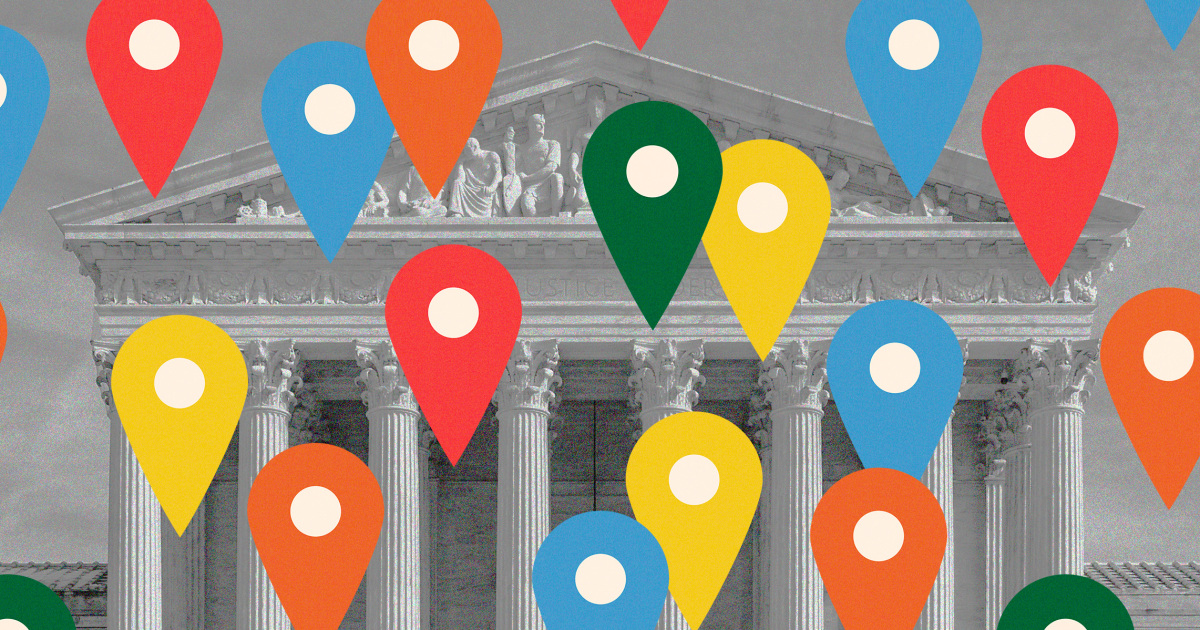
Cover image from nbcnews.com, which was analyzed for this article
Supreme Court examines if police require warrants for cell location records to track criminals. Privacy advocates push back against broad access; law enforcement defends tool efficacy. Ruling could redefine surveillance bounds.
PoliticalOS
Monday, April 27, 2026 — Politics
The Supreme Court must decide whether geofence warrants, which compel tech companies to search location data from everyone near a crime scene, violate the Fourth Amendment or represent a permissible evolution of investigative tools. Lower courts found this particular warrant valid given its narrow scope and supporting evidence from bank video, yet the technique's ability to sweep up innocent bystanders raises legitimate questions about mass digital searches. A ruling either way will shape police access to the constant location records created by modern smartphones, even as Google's own policy changes may reduce the tool's practical availability.
What outlets missed
Both outlets underplayed the precise parameters of the warrant in this case, a 150-meter radius over approximately one hour that returned data on just 19 accounts before narrowing, facts that lower courts cited when finding probable cause. They also gave short shrift to the Eastern District of Virginia and Fourth Circuit rulings that explicitly upheld the geofence warrant as lawful, procedural history that shows multiple layers of judicial review before the Supreme Court step. The scale of the tool's real-world use, more than 11,000 geofence warrants received by Google in 2020 alone according to its transparency reports, received almost no attention despite illustrating why the stakes extend far beyond one Virginia bank robbery. Finally, neither story fully reconciled Google's policy shift, under which Location History now defaults to on-device storage, with the company's simultaneous amicus argument that such digital records still deserve Fourth Amendment safeguards.
Police need every tool to solve violent crimes, yet the digital dragnet required to catch one Virginia bank robber now threatens to redraw constitutional lines on government surveillance. On Monday, the Supreme Court heard arguments in Chatrie v. United States over whether investigators needed a warrant to obtain Google location data that identified Okello Chatrie as the armed robber who stole $195,000 from a Midlothian credit union on May 20, 2019. The case pits Fourth Amendment protections against a law enforcement technique that has become routine as smartphones constantly track movement.
The central tension is whether a "geofence warrant" ordering Google to search its Location History database for every device within a defined area and time frame counts as a search requiring probable cause, or whether users who opt into sharing their data have surrendered any expectation of privacy. In this instance, according to court records and briefs filed with the Supreme Court, a federal magistrate approved the warrant after detectives saw a man on bank surveillance video holding a cellphone. The geofence covered a 150-meter radius for roughly one hour around the robbery; Google initially identified 19 accounts with Location History enabled. Iterative narrowing by investigators led them to Chatrie, whose data placed him at the scene shortly before the crime and showed him leaving immediately afterward. He was convicted of armed robbery and brandishing a firearm.
Lower courts, including the Eastern District of Virginia and the Fourth Circuit, upheld the warrant as supported by probable cause given the narrow parameters and corroborating evidence. Chatrie's lawyers counter that the technique is inherently a "search first and develop suspicions later" approach the Fourth Amendment was written to prevent. It can sweep in data from hundreds or thousands of bystanders. The Justice Department maintains that people voluntarily share this information with Google, that the movements involved were public, and that the three-step warrant process with a magistrate provided sufficient safeguards. The government brief warned that ruling against such warrants would effectively ban them entirely and outpace ongoing legislative and common-law development of digital privacy rules.
This is not the court's first encounter with location tracking. In its 2018 Carpenter v. United States decision, justices required warrants for cell-tower data revealing long-term movements. Geofence warrants differ by seeking information from all devices in a geographic "fence" rather than targeting one person. Privacy groups argue the tool risks abuse against protesters, worshippers or political gatherings. Law enforcement cites its value in cases where traditional leads are absent. Google told the court it no longer responds to geofence requests for Location History because the data now resides primarily on users' devices rather than company servers, though the company urged Fourth Amendment protection for remotely stored digital records.
Oral arguments on April 27, 2026, mark the final week of the term for such hearings, with a decision expected by late June. The outcome will shape how police investigate crimes in an era when phones generate constant location records, determining whether judges must continue approving these warrants or if broader access becomes constitutionally permissible. Both the specific facts of Chatrie's robbery and the wider implications for millions of daily location pings hung over the proceedings.
More in Politics

Federal Agents Search Omar Home in Ongoing Immigration Probe
Homeland Security agents searched the Minnesota Democrat's DC residence in a criminal probe, prompting accusations of political intimidation from Omar and Democratic leaders. Coverage spans left-leaning outlets like NPR, BBC, and The Guardian alongside right-leaning criticism from The Federalist and Daily Wire.

Trump Diesel Import Plan Draws Pushback Over Russia Ties
The weekend agreement drew bipartisan congressional pushback and criticism from Ukraine's Zelenskyy, with analysts downplaying US fuel price impacts. Right-leaning outlets like National Review, Dispatch, and Washington Examiner questioned its legality and effectiveness.

Independents Test Voter Appetite for Middle Ground in 2026 Midterms
Nearly 200 independents are running in competitive races as voters weigh ballot measures on housing costs in states like Massachusetts. Left-leaning coverage from NYT, NPR, and Guardian highlights turnout and key races while right outlets focus on GOP strategy.
Trump Rallies in Alaska, Ohio to Bolster GOP Senate Candidates
The president rallied in Wasilla for Sen. Dan Sullivan and faced empty seats at an Ohio event amid midterm concerns. Outlets across the spectrum covered the trips as signals of GOP vulnerability weeks before Election Day.
The Compass
You just read five takes on one story.
What's your take? Find your political shape in a few minutes.
Take the test