
Supreme Court Tightens Rules on Race in Redistricting, Limiting Voting Rights Act Claims
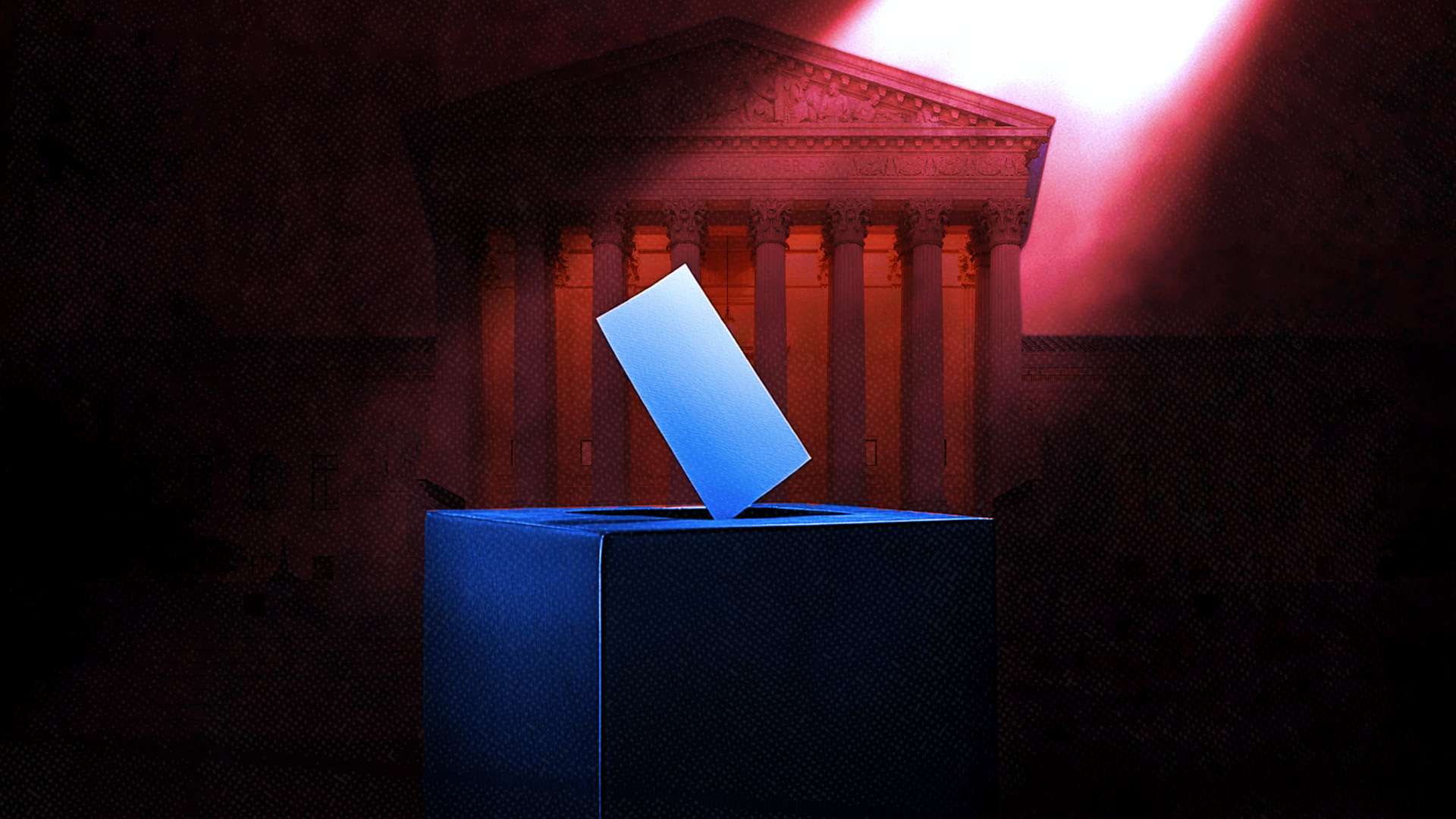
Cover image from reason.com, which was analyzed for this article
The Supreme Court issued a ruling restricting a key provision of the Voting Rights Act that prohibits racial gerrymandering, making it harder for challengers to prove race was the predominant factor in drawing district lines. Left-leaning outlets decry the decision as undermining minority voting power and enabling GOP advantages, while right-leaning sources celebrate it as a victory against racial preferences in politics. The ruling could force states to redraw maps and shift House seats ahead of future elections.
PoliticalOS
Thursday, April 30, 2026 — Politics
The Supreme Court has clarified that the Voting Rights Act cannot compel states to draw districts in which race is the predominant factor; such maps must still satisfy strict constitutional scrutiny. This narrows—but does not eliminate—Section 2's role in protecting against vote dilution. The single most important thing to understand is that the ruling enforces a boundary between remedying discrimination and engaging in racial classification, leaving legislatures and lower courts to apply the tighter standard going forward.
What outlets missed
Most coverage omitted that the invalidated Louisiana district connected disparate Black communities across 200 miles in a non-compact shape, a detail the majority opinion cited as proof race predominated over traditional criteria. The procedural sequence received short shrift: the map was drawn to comply with a lower-court finding of vote dilution under Section 2; a separate suit by non-Black voters then successfully challenged it as an unconstitutional racial gerrymander. Several outlets failed to note that some Black voters supported the challengers, objecting to being sorted primarily by race. Claims of 12 to 19 specific House seats at immediate risk were frequently repeated without attribution to verifiable data and were not corroborated across neutral legal sources such as SCOTUSblog. The majority did not strike down Section 2 or overrule its core precedents; it clarified that the statute cannot compel maps that violate the Equal Protection Clause.
The Supreme Court has made it substantially harder for challengers to force states to draw congressional districts primarily on the basis of race. A 6-3 decision issued April 30, 2026, struck down a Louisiana map that added a second majority-Black district, ruling that the Voting Rights Act did not require it and that the map violated the Constitution's Equal Protection Clause by letting race predominate over traditional districting criteria. The stakes are concrete: fewer guaranteed majority-minority districts in Southern states, potential shifts in House representation, and a new legal framework that demands stronger proof before courts can compel race-conscious remedies.
At the center of the tension sits a contradiction built into decades of precedent. Section 2 of the 1965 Voting Rights Act, as amended in 1982, prohibits electoral practices that dilute minority voting strength. It has produced dozens of majority-Black and Hispanic districts since the civil rights era. Yet the 14th and 15th Amendments bar government from sorting citizens by race except in the narrowest circumstances. Louisiana's post-2020 map initially contained one majority-Black district despite Black residents comprising roughly one-third of the state's population. Black voters and advocacy groups sued under Section 2, a federal court agreed the original map diluted their strength, and the Republican-led legislature responded in 2024 by drawing a second such district. A separate group of non-Black voters then sued, arguing the new map engaged in the very racial gerrymandering the Constitution forbids. Lower courts agreed. The Supreme Court affirmed.
Justice Samuel Alito's majority opinion, joined by Chief Justice John Roberts and Justices Clarence Thomas, Neil Gorsuch, Brett Kavanaugh and Amy Coney Barrett, returned to first principles. "Section 2 of the Voting Rights Act of 1965 was designed to enforce the Constitution—not collide with it," Alito wrote. Lower courts had sometimes read the law to compel states to prioritize race even when traditional criteria such as compactness, contiguity and respect for political subdivisions pointed elsewhere. The revised framework requires plaintiffs to produce illustrative maps that satisfy all legitimate state districting goals, including partisan objectives, before race can be deemed the predominant motive. Partisan gerrymandering, declared nonjusticiable by the Court in 2019's Rucho v. Common Cause, cannot be repackaged as a racial claim. Thomas, joined by Gorsuch, concurred but would have gone further and held Section 2 inapplicable to redistricting entirely.
Justice Elena Kagan dissented for the three liberal justices. She argued the majority had rewritten the statute and its own precedents, imposing hurdles that will render successful Section 2 claims "nearly impossible" in racially polarized electorates. "The Voting Rights Act was born of the literal blood of Union soldiers and civil rights marchers," Kagan wrote. She warned that the decision invites states to pursue aggressive partisan maps that disproportionately harm minority voters so long as they avoid explicit racial language.
The procedural backstory matters. Louisiana drew the contested map—Senate Bill 8—to comply with an earlier federal court order finding vote dilution. That order followed the 2020 census. The second district stretched roughly 200 miles, linking disparate Black communities while bypassing more compact alternatives, a fact the majority cited as evidence that race had predominated. Challengers included Black voters who objected to being classified and grouped chiefly by skin color. These details, drawn from the Supreme Court opinion and SCOTUSblog's contemporaneous reporting, were omitted or minimized in many accounts.
Reactions split sharply along predictable lines. Congressional Black Caucus Chair Yvette Clarke called the ruling "an outright power grab" aimed at "silencing Black voices." Alabama Attorney General Steve Marshall praised it for rejecting "a racial quota system the Constitution forbids." Republican governors in Louisiana, Mississippi and elsewhere signaled plans to redraw maps, though tight election calendars may limit changes before the 2026 midterms. Democratic-led states have begun exploring countermeasures, including adjustments to their own maps or independent redistricting reforms. Legal experts on both sides expect a wave of new litigation testing the updated Gingles preconditions established in the 1986 Thornburg v. Gingles case; how lower courts apply the "strong inference" of intentional discrimination standard remains unresolved.
This decision builds on a trilogy of prior rulings. In 2013's Shelby County v. Holder the Court invalidated the coverage formula for Section 5's preclearance requirement, citing vast improvements in minority registration and turnout. In 2021's Brnovich v. Democratic National Committee it imposed stricter limits on Section 2 challenges to voting rules. In 2023's Allen v. Milligan it upheld Section 2's use in Alabama but cautioned against excessive racial predominance. The Louisiana case clarifies the boundary: compliance with Section 2 can justify some race-conscious drawing, but only if it survives strict scrutiny and does not subordinate traditional criteria.
Predictions of exact seat changes vary and could not be independently verified. Some analysts cited by NPR and the Washington Post forecast the potential loss of up to a dozen or more majority-minority districts in the South by 2028, possibly the largest drop in Black congressional representation since Reconstruction. Others, including election lawyer Jason Torchinsky, expect more modest effects in the near term because many existing districts align with partisan rather than purely racial goals. Louisiana already maintains one majority-Black district centered on New Orleans; its second district was the one invalidated. Black voter turnout and registration rates have reached near parity with white rates in many Southern states, a fact Alito noted, yet racially polarized voting persists.
The ruling leaves Section 2 formally intact. Challengers may still prevail by showing that minority voters are sufficiently numerous and geographically compact to form a majority in a reasonably configured district, that they vote cohesively, and that the majority votes sufficiently as a bloc to usually defeat their preferred candidate. But illustrative maps must now also achieve the state's legitimate political objectives. The central unresolved question is whether this tightened standard will, in practice, allow Southern legislatures to reduce minority opportunity districts without triggering successful lawsuits. Lower courts will spend years answering it. Congress retains authority to amend the statute if it disagrees with the Court's interpretation.
More in Politics

Federal Agents Search Omar Home in Ongoing Immigration Probe
Homeland Security agents searched the Minnesota Democrat's DC residence in a criminal probe, prompting accusations of political intimidation from Omar and Democratic leaders. Coverage spans left-leaning outlets like NPR, BBC, and The Guardian alongside right-leaning criticism from The Federalist and Daily Wire.

Trump Diesel Import Plan Draws Pushback Over Russia Ties
The weekend agreement drew bipartisan congressional pushback and criticism from Ukraine's Zelenskyy, with analysts downplaying US fuel price impacts. Right-leaning outlets like National Review, Dispatch, and Washington Examiner questioned its legality and effectiveness.

Independents Test Voter Appetite for Middle Ground in 2026 Midterms
Nearly 200 independents are running in competitive races as voters weigh ballot measures on housing costs in states like Massachusetts. Left-leaning coverage from NYT, NPR, and Guardian highlights turnout and key races while right outlets focus on GOP strategy.
Trump Rallies in Alaska, Ohio to Bolster GOP Senate Candidates
The president rallied in Wasilla for Sen. Dan Sullivan and faced empty seats at an Ohio event amid midterm concerns. Outlets across the spectrum covered the trips as signals of GOP vulnerability weeks before Election Day.
The Compass
You just read five takes on one story.
What's your take? Find your political shape in a few minutes.
Take the test