
Trump Reviews Iran's 14-Point Peace Offer as War Hits Day 65

Cover image from theblaze.com, which was analyzed for this article
President Trump is reviewing Iran's 14-point proposal to end the war, including lifting the US naval blockade and reopening the Strait of Hormuz, but doubts it is sufficient as Tehran has not 'paid a big enough price.' The costly and unpopular conflict enters its 65th day, with massive job losses in Iran from 'Operation Economic Fury' and civilian fears across the Middle East. Senate Republicans have blocked war powers resolutions multiple times.
PoliticalOS
Sunday, May 3, 2026 — Politics
The single most important reality is that diplomacy has not yet overcome the core impasse: Iran's insistence on sanctions relief, nuclear rights, and an end to the U.S. blockade versus the administration's demand that Tehran verifiably abandon weapons-grade enrichment and 'pay' for decades of regional behavior. With oil prices elevated, civilian infrastructure damaged across multiple countries, and fragile ceasefires already cracking in Lebanon, the coming review will test whether economic pain and political risk can force compromise before active combat resumes. Readers should track verifiable actions around the strait and nuclear sites rather than competing rhetoric.
What outlets missed
Most coverage omitted the multiple times Senate Republicans blocked war powers resolutions, a key detail on domestic checks that limits Trump's flexibility. Reports also underplayed the scale of Iranian job losses specifically tied to 'Operation Economic Fury,' an economic warfare campaign that has compounded civilian hardship beyond general sanctions. Pre-ceasefire Iranian enrichment levels approaching weapons-grade and proxy attacks via Hezbollah and Houthis in late 2025 were rarely placed in full sequence, leaving the February 28 strikes without documented context from IAEA reports. Reciprocal casualty figures, including dozens killed by Iranian missiles in Gulf states and Israel, received only token mention in outlets focused on one side's suffering. Finally, technical details on Iranian sea mines still obstructing the Strait of Hormuz were mentioned sporadically but never tied to the feasibility of any 'new mechanism' in the 14-point plan.
Global oil prices climbed above $111 a barrel this week. Iranian families grapple with mass layoffs and power outages. Lebanese villages emptied under new evacuation orders. In the middle of it all, President Donald Trump is personally reviewing a 14-point Iranian proposal to end a conflict now entering its 65th day.
The central tension remains unresolved: whether Tehran will accept strict limits on its nuclear program and navigation through the Strait of Hormuz in exchange for sanctions relief and an end to the U.S. naval blockade, or whether the Trump administration will insist on further concessions. Iranian state media reported the proposal late Thursday via Pakistani mediators. It calls for non-aggression guarantees, U.S. troop withdrawals from the region, release of frozen assets, lifting of sanctions, war reparations, cessation of hostilities including in Lebanon, and a new mechanism to manage shipping in the Strait of Hormuz. According to Tasnim News Agency, Tehran wants all issues resolved within 30 days rather than the two-month ceasefire extension previously floated by Washington.
Trump told reporters Saturday he had been briefed on the "concept of the deal" but expressed skepticism. In a Truth Social post he wrote that it was "difficult to imagine" the proposal would prove acceptable because Iran "has not yet paid a big enough price for what they have done to Humanity, and the World, over the last 47 years." He did not rule out renewed strikes. "If they do something bad, there is a possibility it could happen," he said. The comments came one day after he had already dismissed an earlier 10-point Iranian plan.
The war began February 28 with U.S. and Israeli strikes on Iranian nuclear facilities, missile sites and proxy infrastructure, according to timelines compiled by the Congressional Research Service and Wikipedia entries drawing from multiple intelligence reports. Iran retaliated by closing the Strait of Hormuz, through which one-fifth of global oil and gas transit. A ceasefire took effect April 8 after Pakistani mediation, yet parallel naval blockades persist. Iranian vessels have been intercepted. One supertanker evaded restrictions and delivered 1.9 million barrels to Asia, according to tanker tracking data. Mines remain a technical obstacle to reopening the strait.
Civilian life across the region has been upended. In Isfahan, residents woke to explosions that silenced radio towers. In Tehran, text messages described streets where "nowhere is safe." A Palestinian-American woman in Jerusalem spoke of a "fear that settles in your heart and never leaves." Lebanese families fled Dahiyeh suburbs under Israeli bombardment; one man told Reason magazine he no longer knows whether his ancestral village still stands. In Lamerd and Minab, Iranian parents lost children when missiles struck a school gym and elementary facility during the opening hours of the conflict. Reason magazine, which interviewed civilians on all sides under changed names for safety, reported desensitization in some quarters: Baghdad rooftop spectators filming Iranian drones, nonchalant subway crowds in Tehran after blasts. Yet holidays offered no respite. Nowruz dinners were interrupted by sirens. Passover seders moved into bunkers.
Economic pressure compounds the human cost. Iran has suffered what local reports describe as "Operation Economic Fury," producing massive job losses and empty store shelves. Kuwait and Saudi Arabia saw intermittent power disruptions when infrastructure came under fire. India rationed cooking gas. U.S. gasoline prices jumped from roughly $3 to over $4 a gallon, prompting some American households to skip meals, per CNN and USA Today reporting. The longer the Hormuz impasse lasts, the wider the ripple effects.
Domestic politics add another layer. The conflict remains unpopular. Senate Republicans have blocked war powers resolutions multiple times, according to congressional records. Trump's approval ratings have fallen, though Republican support for his handling of the crisis hovers near 65 percent in some Reuters/Ipsos polling. Former Fox News host Tucker Carlson, once a Trump ally, told the New York Times he believed the president launched the campaign "against his will" and felt like "more a hostage than a sovereign decision maker." Carlson cited conversations in which Trump acknowledged the political risk. Those perceptions could not be independently verified beyond the published interview. Bloomberg has reported pressure from Israeli Prime Minister Benjamin Netanyahu and others, but specific allegations of blackmail remain unconfirmed.
On the ground, fragile ceasefires show strain. Israel conducted 50 strikes in southern Lebanon in a single 24-hour period, killing 41 according to Lebanese authorities, even after an April 16 truce. The death toll in that theater has reached 2,659. Hezbollah has launched drones and rockets in response. The Islamic Revolutionary Guard Corps stated it remains on "full standby," warning that Trump faces a choice between "an impossible military operation or a bad deal." Tehran seized on Trump's description of the U.S. blockade as "a very profitable business" and "sort of like pirates," calling it an admission of criminality.
Previous proposals highlight the gap. A U.S. nine-point plan from March demanded permanent dismantling of nuclear sites at Natanz, Isfahan and Fordow, handover of enriched uranium stockpiles to the IAEA, and full monitoring. Iran rejected it as a prelude to further attacks and countered with its own 10-point plan. Nuclear enrichment remains the clearest red line for Trump; Iranian officials insist on their NPT rights. Experts quoted across outlets, including Kenneth Katzman of the Soufan Center and Paul Musgrave of Georgetown University in Qatar, describe mistrust as the larger barrier. Trita Parsi of the Quincy Institute argued the U.S. blockade has backfired, driving oil prices higher during ceasefire than during active fighting.
Whether the current proposal narrows those differences will become clearer in coming days. Pakistani mediators continue efforts in Islamabad. A U.S.-led Maritime Freedom Construct coalition is forming to coordinate sanctions enforcement and freedom of navigation. Trump has also signaled plans to withdraw thousands more troops from Germany amid transatlantic friction over the war.
The stakes extend beyond any single diplomatic exchange. Renewed hostilities risk thousands more casualties, deeper economic damage, and wider regional destabilization. A successful deal could restore energy flows, ease civilian hardship, and set new terms for Iran's place in the international order. For now, the blockade holds. The reviews continue. And across multiple capitals, the fear that the worst may not be over settles in.
More in Politics

Trump Rejects Iran's Seven-Day Hormuz Reopening Offer
President Trump dismissed Iran's offer to reopen the Strait of Hormuz in exchange for sanctions relief, calling it unacceptable amid ongoing Middle East tensions. The move follows indirect talks and is tied to midterm political calculations.

Democrats Outline Post-Midterm Oversight of Trump Administration
If Democrats win the midterms, expansive investigations into Trump, his family, and administration are planned, with impeachment as a possible tool.
White House Drops CNN from Air Force One Pool After Court Ruling
The Trump administration barred CNN from the presidential travel pool for a trip to Tennessee, escalating a dispute over media access despite a recent court order restoring some outlets' White House credentials. Left-leaning outlets framed it as a First Amendment crisis while right-leaning sources portrayed it as justified pushback against biased coverage.
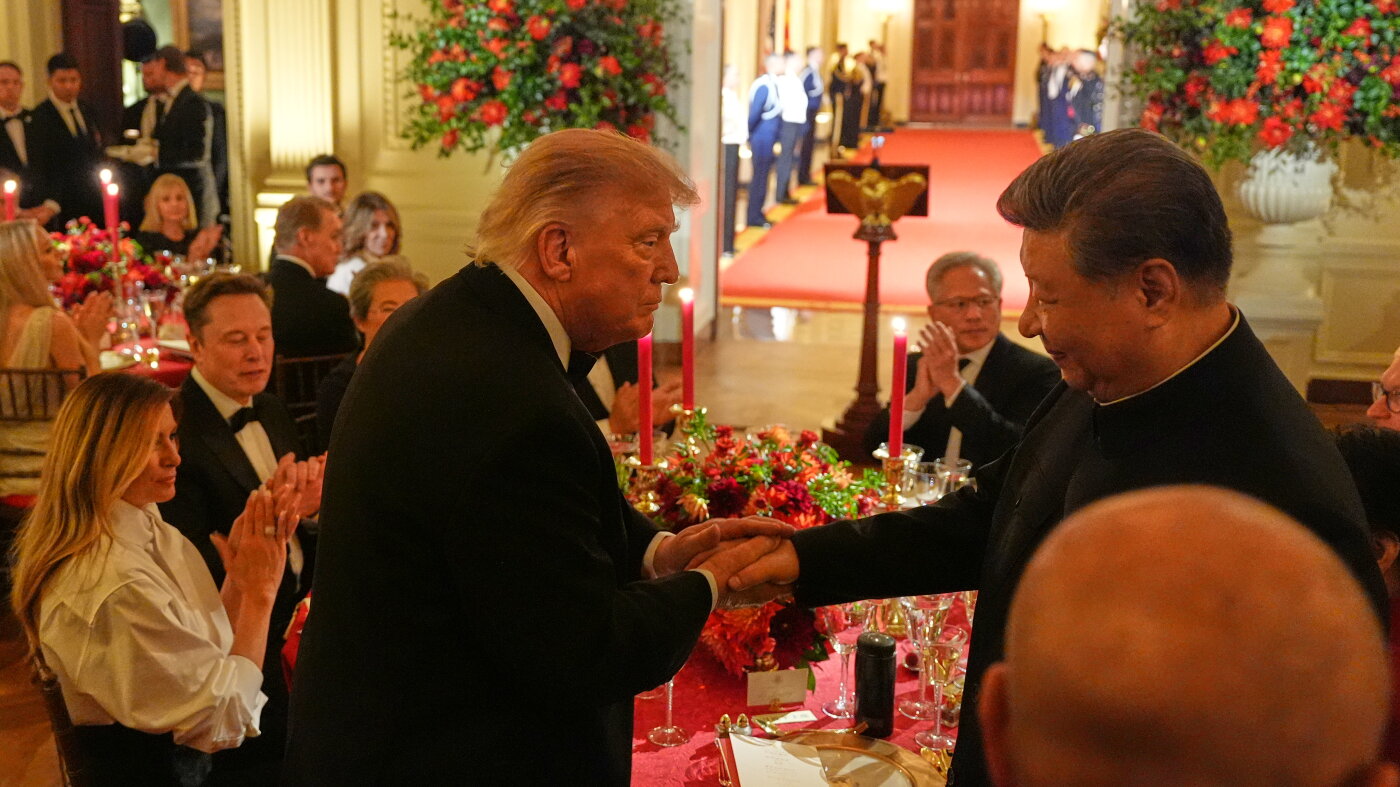
Trump Hosts Xi for State Dinner Focused on Pageantry Amid Trade and AI Strains
President Trump welcomed Chinese President Xi Jinping for high-profile talks on trade, tariffs, AI, and bilateral rivalry, featuring a White House tour and state dinner with tech executives. Coverage highlighted symbolic pomp over major breakthroughs, with both sides maintaining a cordial tone amid persistent tensions.
The Compass
You just read five takes on one story.
What's your take? Find your political shape in a few minutes.
Take the test